 LuxDMX

A DMX node that shows you every channel.
Your lighting software sends Art-Net or sACN, LuxDMX puts it on real DMX cables, and its own web page shows you all 512 channels, who's sending, and how clean the signal is. It runs on a cheap ESP32 and everything, firmware and hardware, is open.
The carrier board.
The easy way to build one. A two-layer board, everything on it hand-solderable, and the hard parts are modules you can buy anywhere: an ESP32-S3 dev board, an RS485 module per DMX port, a W5500 for wired Ethernet, a little OLED and a knob.
- Board
- 100 × 80 mm, 2 layers, 1206 parts
- DMX / RDM
- up to 3 ports, one MAX3485 module each
- Pixels
- up to 5 WS281x ports, buffered to 5 V
- Power
- USB-C or 5 V for the logic, 12–24 V for the pixels through a fuse
- On the board
- 1.3" OLED, encoder, two buttons
Most of the firmware testing happens on this board.
Pixel outputs on the board.
Five outputs for addressable strips next to the DMX ports, 12 or 24 V with a fuse on the board. Give a port a universe and the strip plays it, over Art-Net or sACN.
- WS2812, WS2815, WS2811, SK6812 RGBW, any colour order, gamma and brightness
- Several universes per port, stitched in order, with ArtSync and E1.31 sync
- Up to 9.8 A on the pixel rail, about two 5 m WS2815 runs at full white
 Five pixel ports
A lighting console in your browser.
You don't install anything. Patch your fixtures, build looks and cue lists, and put the show on a timeline with your song. There's a 3D stage, so you can program without any lights, and it plays straight to your LuxDMX.
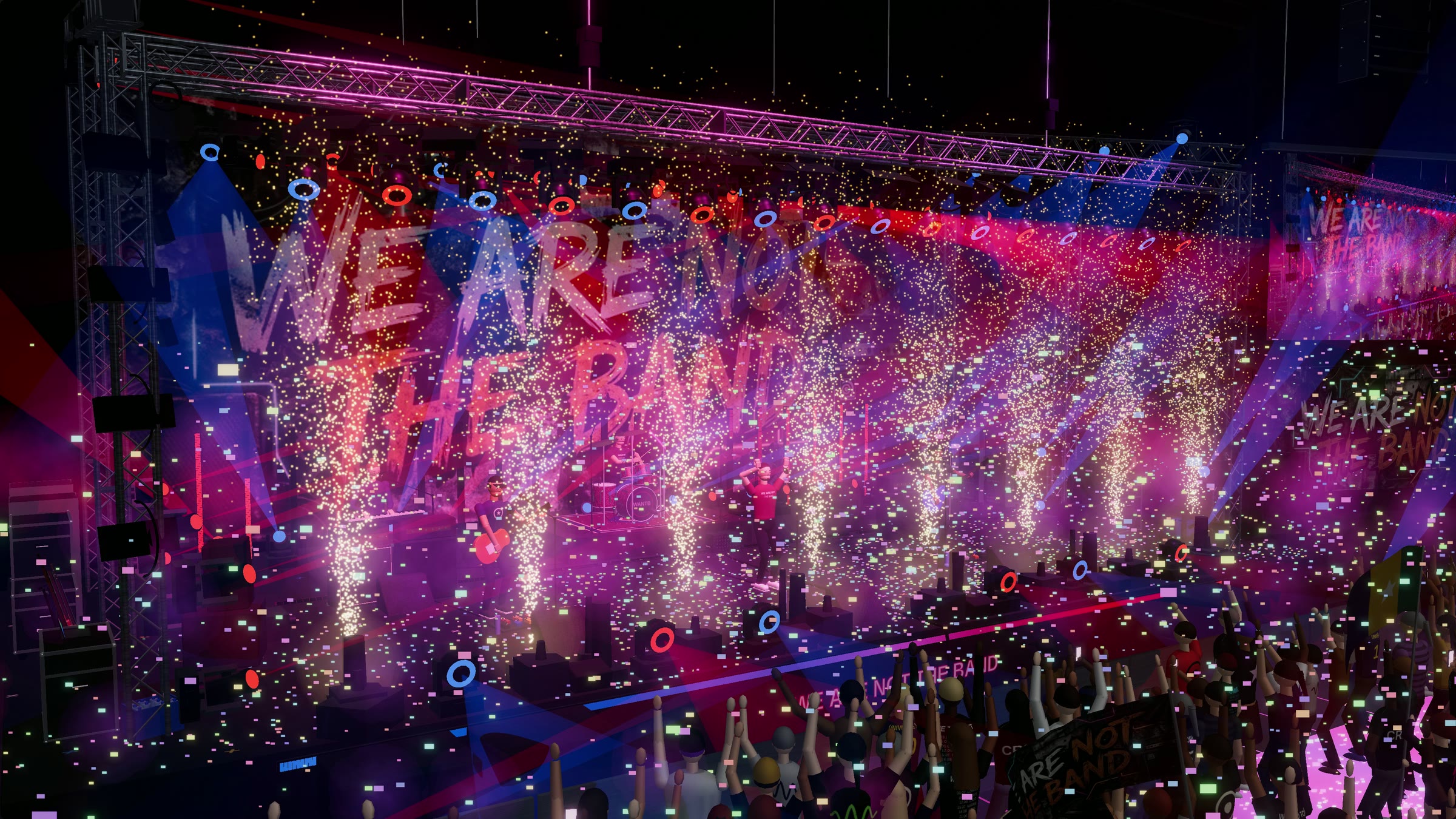
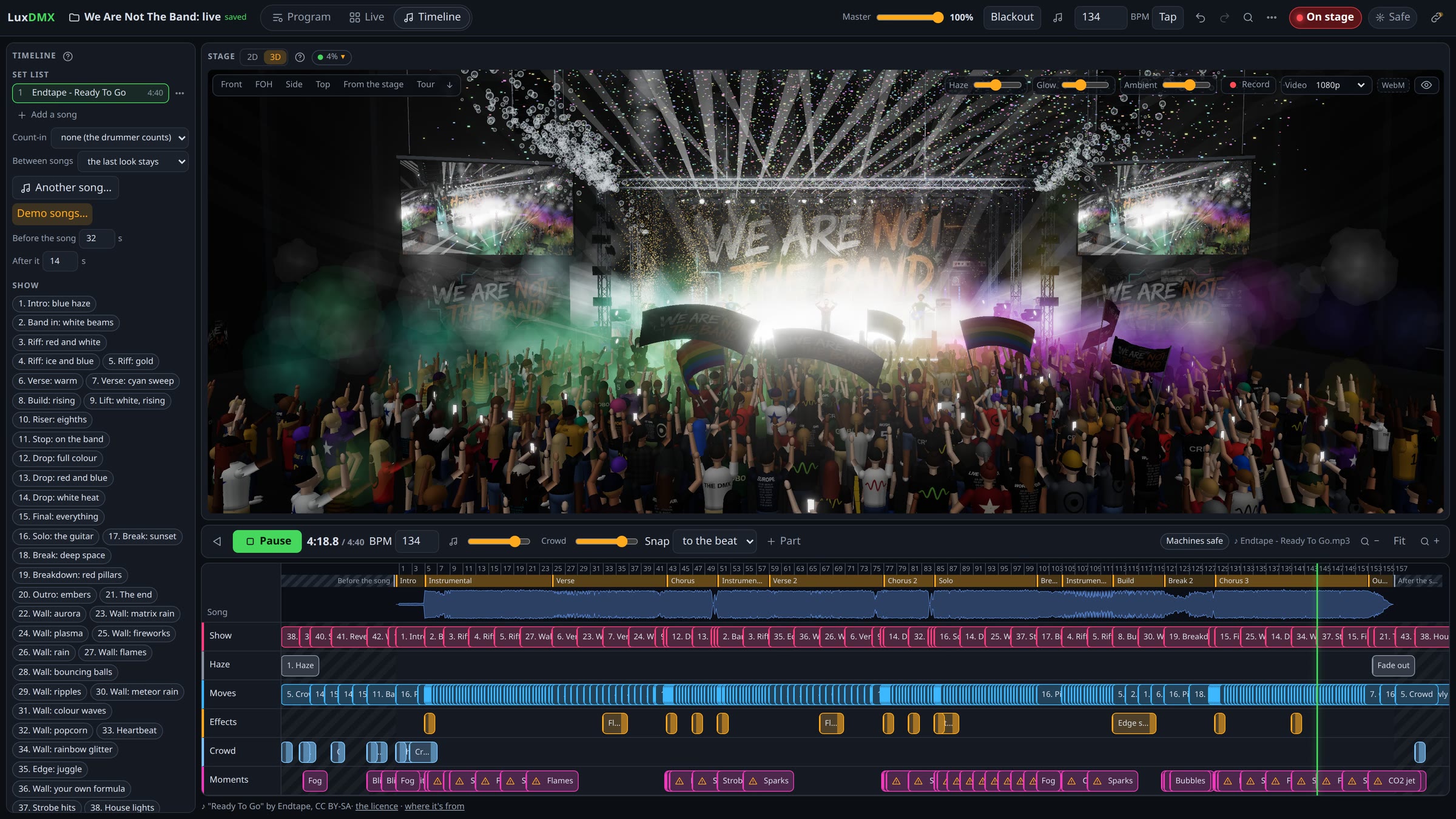
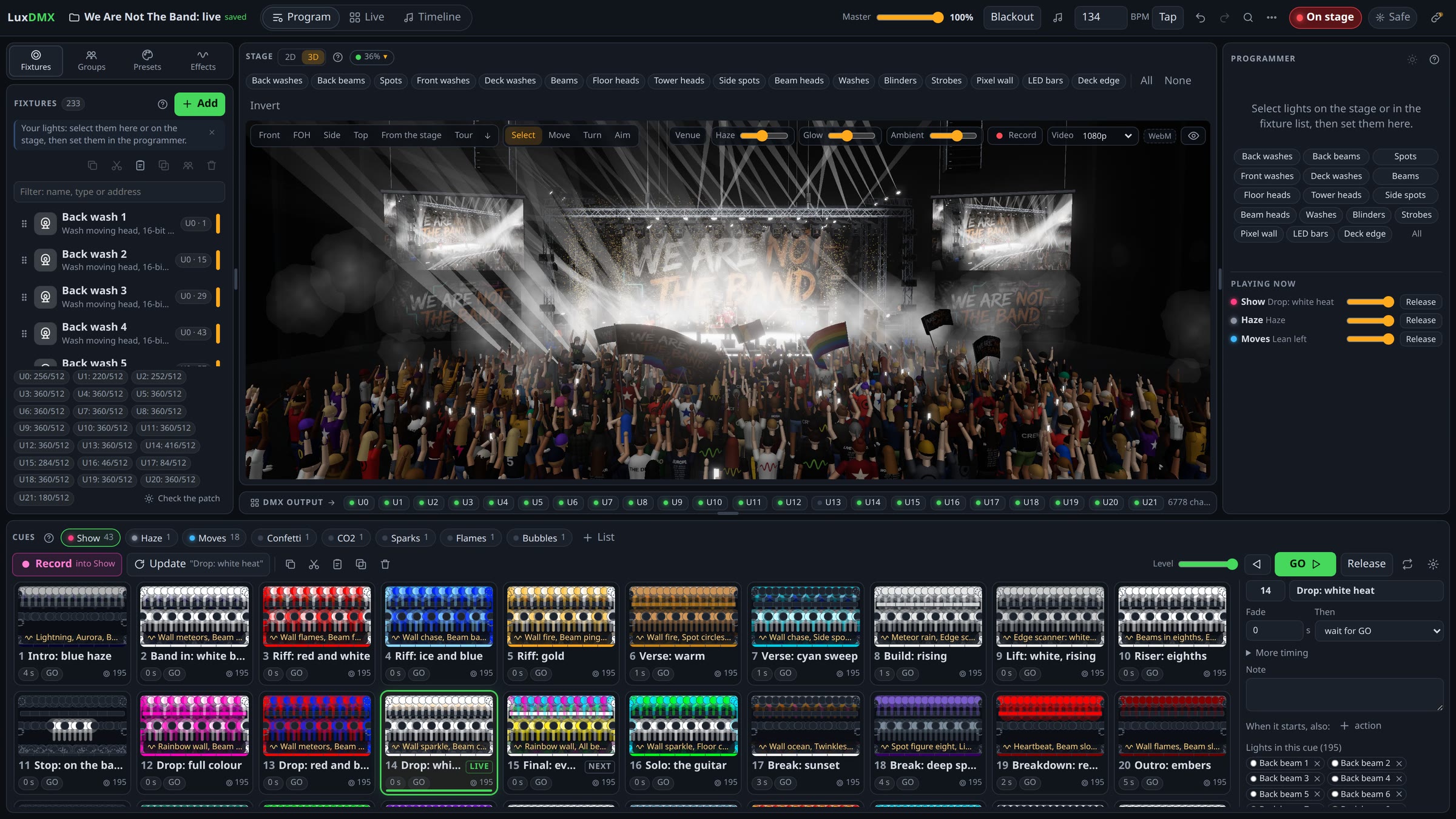
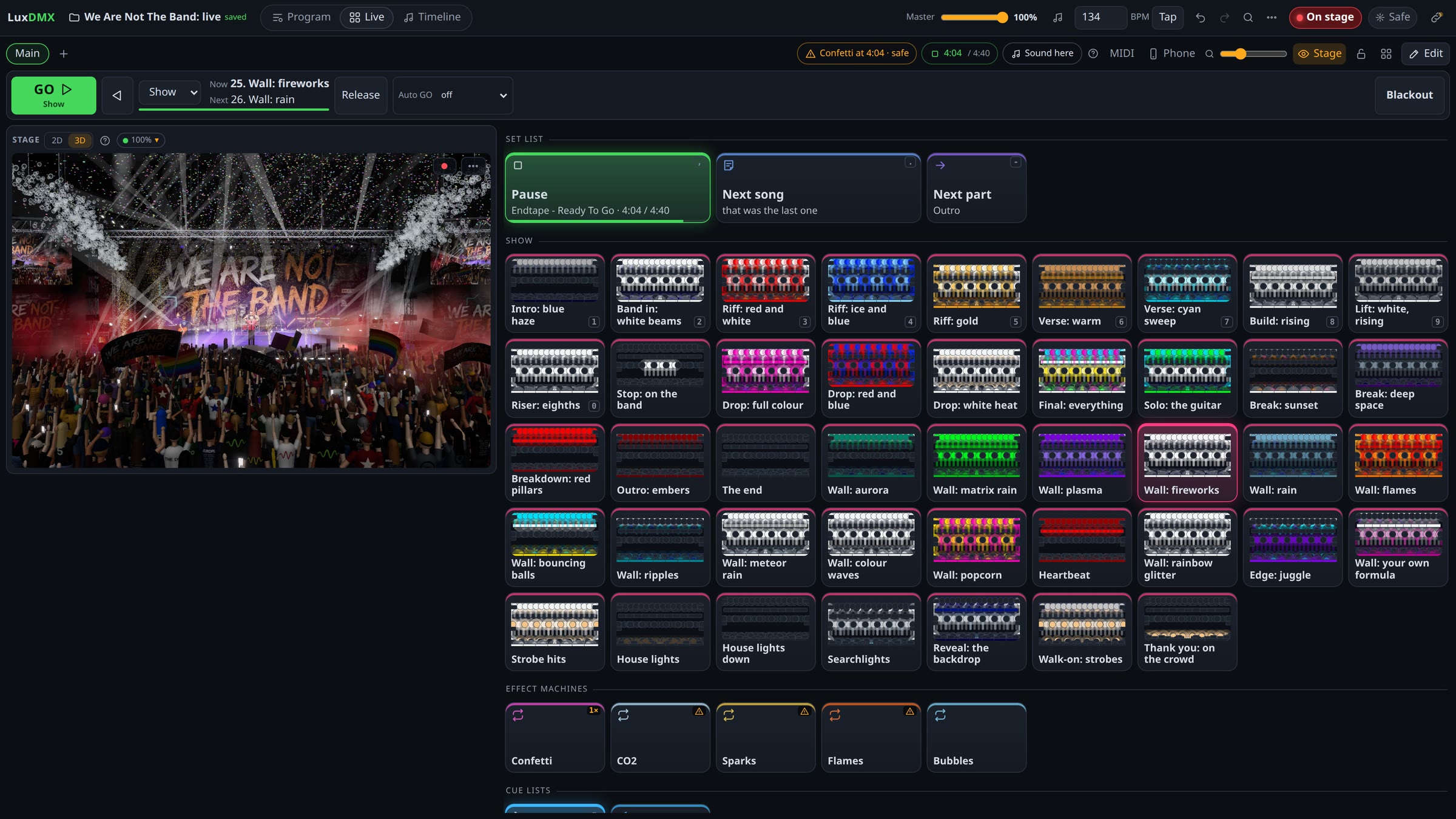
- Plays to your LuxDMX right from the page (firmware v1.0.293 or newer)
- Any Art-Net or sACN node through LuxDMX Link, a small helper for Windows, macOS and Linux
- A phone as a remote: scan a code and you have GO, faders and flash buttons
- Records the stage as a video, 1080p or vertical for phones
See it run.
The carrier board, the pixels, the web page and the Sequencer in a couple of minutes.
Any ESP32 will do.
You don't need the carrier. The firmware knows a long list of boards, and you can set every pin in its settings.
An ESP32 and an RS485 module
The cheapest node there is. For RDM, get a module with a direction pin; the auto-direction kind can't turn the line around.
WT32-ETH01
An ESP32 with Ethernet already on the board. Add an RS485 module and you have a wired node.
Ready-made boards
Profiles for DevKits, Feathers, the Radig ESP32-S3 DMX/RDM node and more, picked from a list in the settings.
The LuxDMX v6 board
Isolated outputs, PoE, a status panel. Designed and routed, but never sent to a fab, so treat it as untested.
Flash one in your browser.
Desktop Chrome or Edge, plug the board in over USB, pick the model, click flash. Always the latest release, no Python, no toolchain.